Animated Donut Chart Generator
Show how parts make up a whole, beautifully. Export as PNG, SVG, GIF or MP4.
Free to try · No design skills · Ready in about two minutes
Trusted by 1,198 users, including people at
 ByteDance
 Arizona State
 Fox
Fox UT Austin
 Roche
Roche Tulane
 United Airlines
 Clemson
 NHS
NHS Ayming
 Marquette
 Kent State
 Ray White
 UC Riverside
 CBA
CBA Illinois Tech
 Venngage
 Hofstra
 House of Communication
 IIT Madras
 Sotherly Hotels
 Zenus.ai
Overview
What is a donut chart?
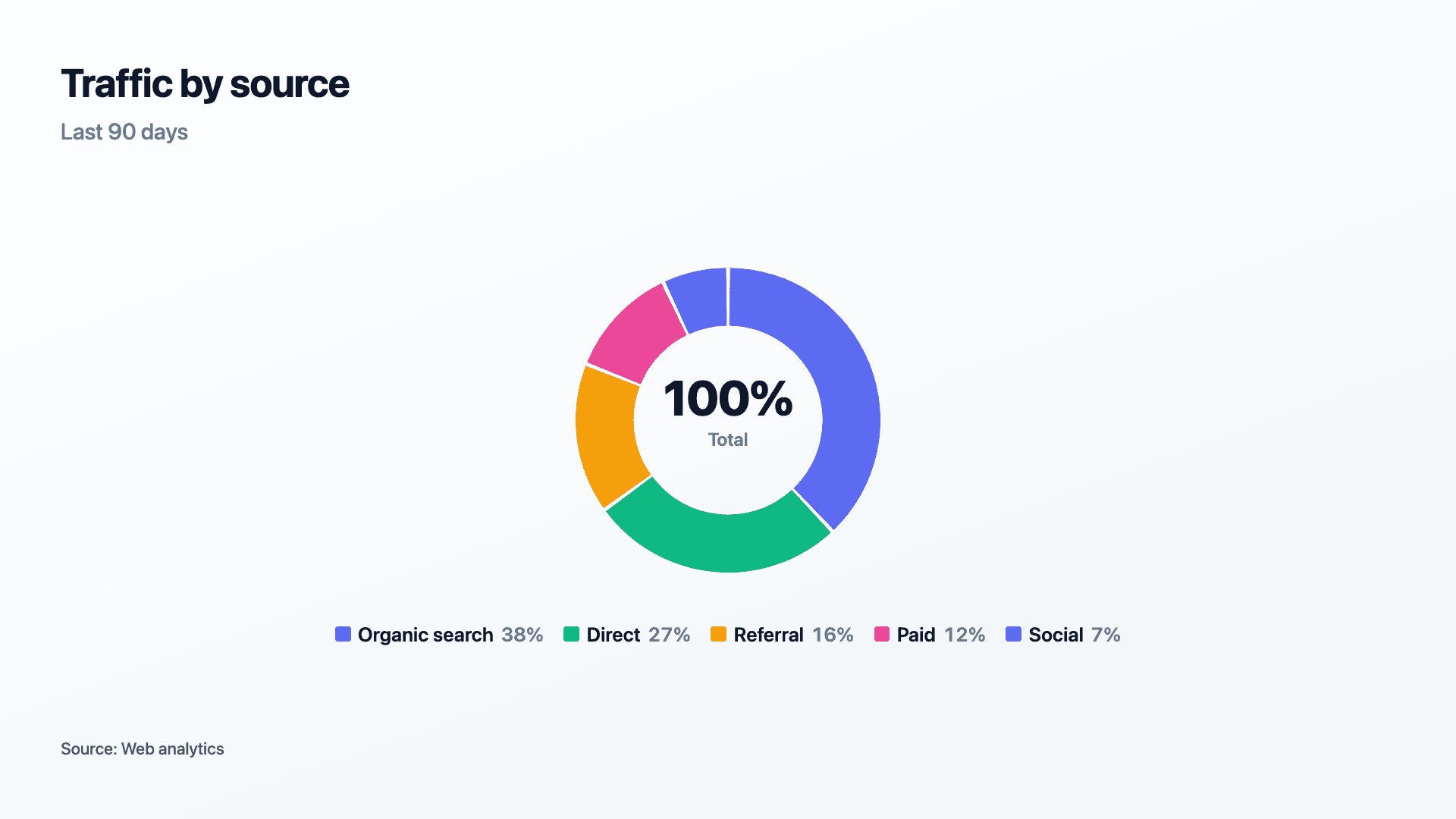
A donut chart, a pie with the centre removed, shows how a single total breaks down into parts, with each slice sized by its share. It answers 'what is the mix?': where traffic comes from, how revenue splits across segments, how a budget is allocated. The hole in the middle reduces visual clutter and leaves space for a label or total.
Its honest use is narrow but real: a few parts of one whole, where the rough proportions are the message. Humans are poor at comparing angles precisely, so a donut is great for 'social is about a third of our traffic' and poor for 'is segment C bigger than segment D by two points?'. When precision matters, a bar chart wins.
Reochart sweeps each slice into place as it animates, which turns a simple split into something polished enough for a post or a deck. Use three to six slices, label them clearly, and export as MP4, GIF, PNG or SVG, on your brand on Pro.
How it works
How a donut chart works
Each value is converted to a share of the total, and that share becomes the slice's angle around the ring. The full circle is 100 percent, so the slices always add up to the whole, which is why a donut is only valid when your categories really are parts of one total.
The ring (rather than a full pie) keeps the shape light and gives you a clean centre for a headline number or label.
Examples
Example donut charts
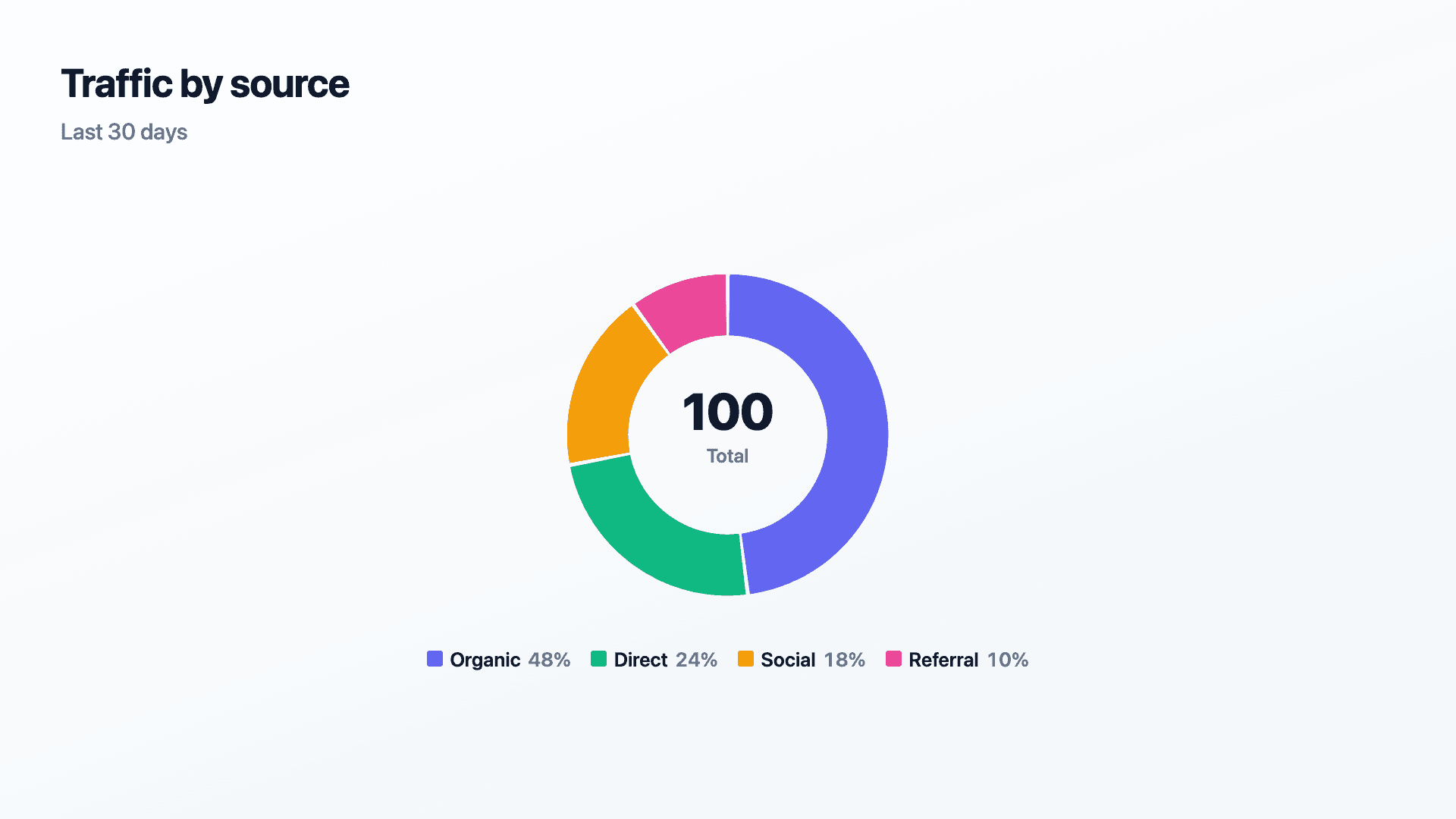
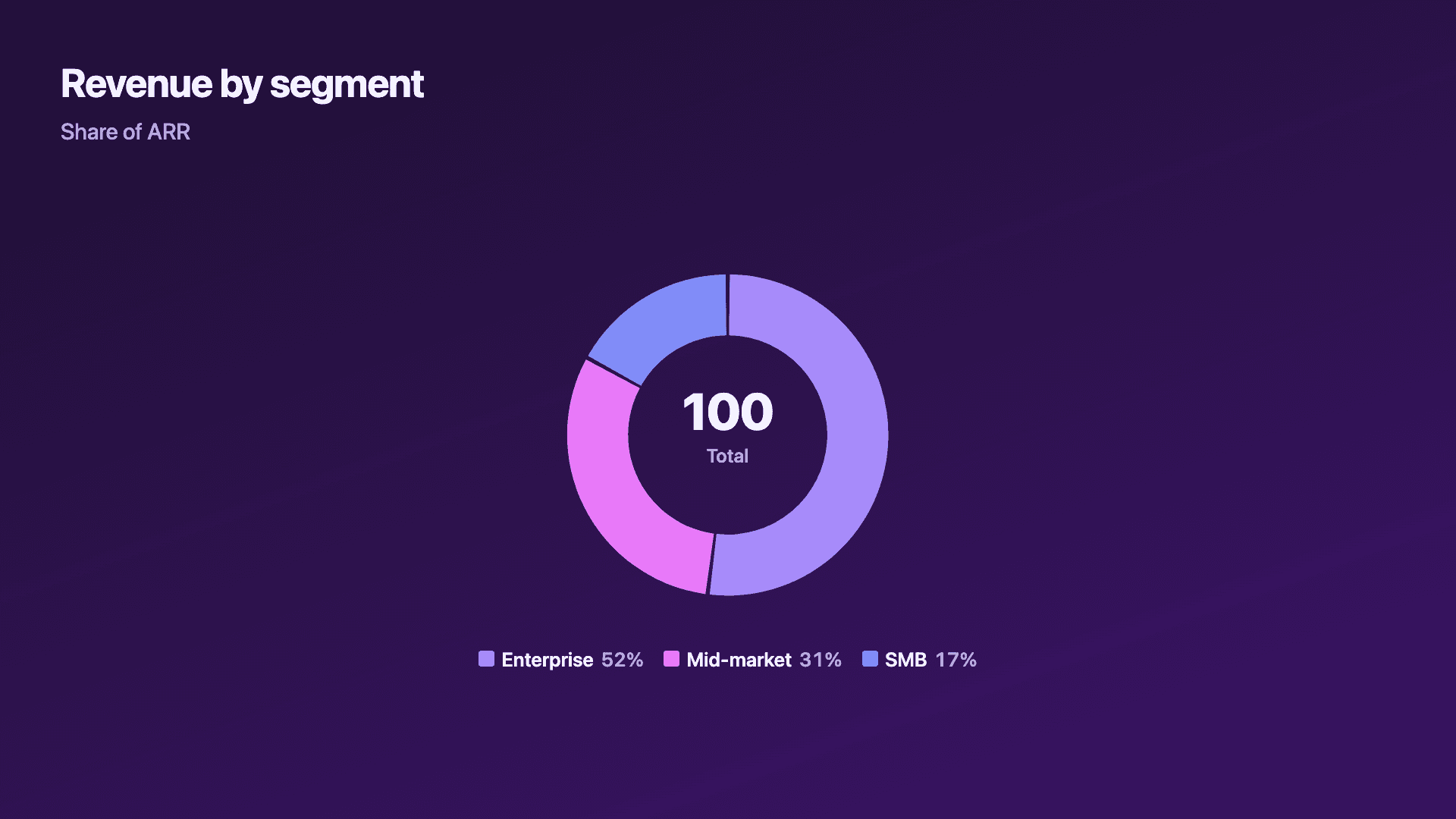
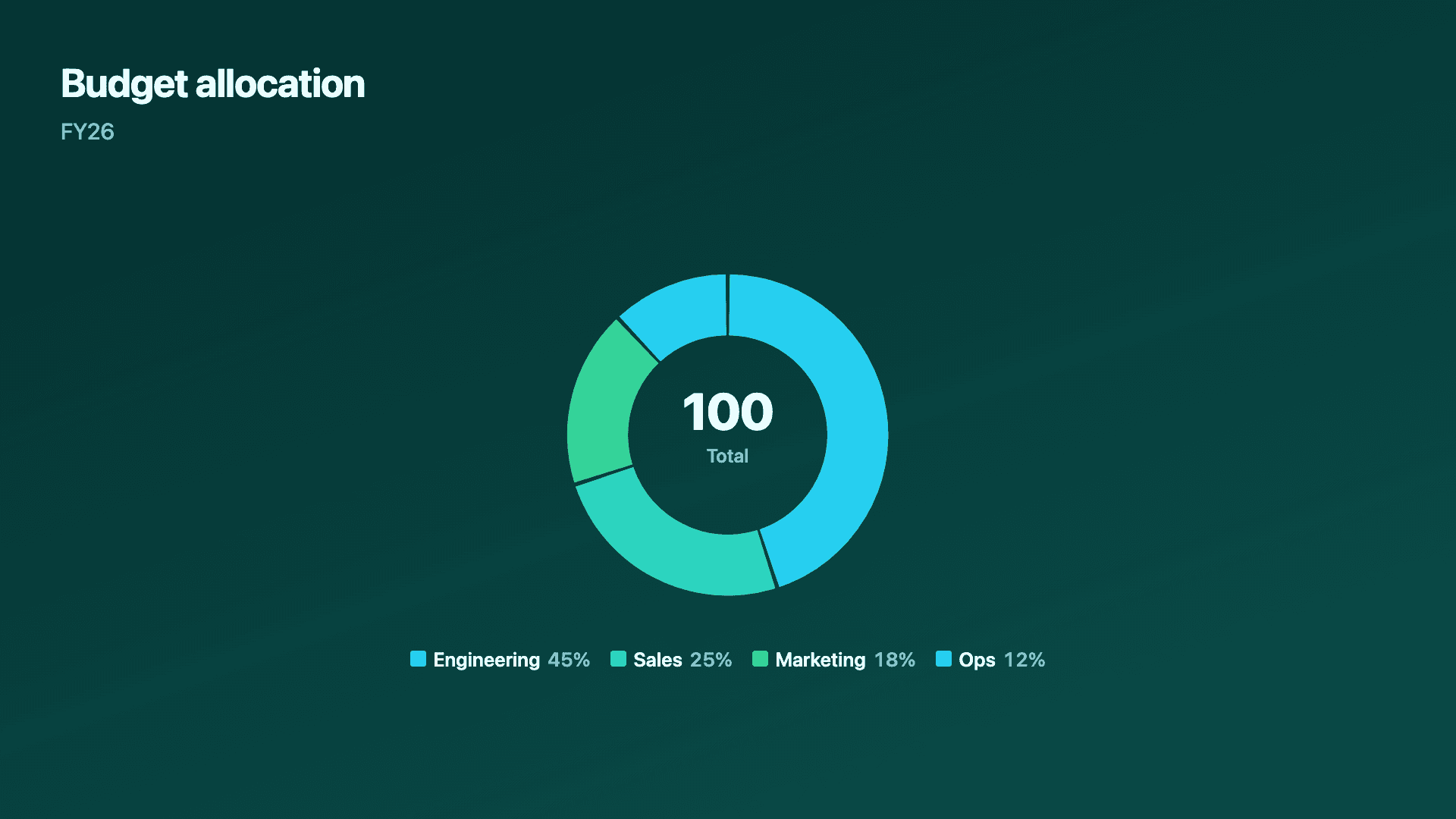
Real charts made in Reochart, each with its own data and theme. They animate automatically as you scroll.
Good fit
When to use a donut chart
- ✓Traffic by source
- ✓Revenue by segment
- ✓Market share
- ✓Budget or spend split
- ✓Any 'parts of one whole' with a few categories
Reach for something else
When not to use a donut chart
- ✕You need precise comparison between slices, use a bar chart, angles are hard to read exactly.
- ✕You have more than about six categories, the slices get thin and indistinct.
- ✕Your categories are not parts of a single total (they do not sum to 100%).
- ✕You are comparing the same split across time or groups, use stacked bars.
Compare
Donut chart vs other charts
Donut vs the alternatives.
| Chart type | Best for | Avoid when |
|---|---|---|
| Donut / pie | Parts of one whole, a few slices | Precise comparison or many slices |
| Bar / column | Comparing category values exactly | Emphasising share of a total |
| Stacked bar | Composition across categories or time | A single one-off split |
| Treemap | Many nested parts of a whole | A handful of simple slices |
Your data
What data you need
One row per slice: a label and a value (counts or percentages both work). Paste from a sheet or import a CSV. 3 to 6 slices reads best.
| Label | Value |
|---|---|
| Organic | 48 |
| Direct | 24 |
| Social | 18 |
| Referral | 10 |
Step by step
How to make a donut chart
Drop your numbers in, or import a CSV.
Choose the chart, theme and animation speed.
Tune colours, labels and add your brand.
Download MP4, GIF, PNG or SVG.
Best practices
Get it right
- ✓Keep to 3-6 slices so each is easy to tell apart.
- ✓Order slices largest to smallest for a clean read.
- ✓Label each slice with its share directly.
- ✓Use it only when the parts sum to a meaningful whole.
- ✕Use a donut to compare values precisely, bars do that better.
- ✕Cram in 8+ thin slices nobody can distinguish.
- ✕Make people match a separate legend to tiny slices.
- ✕Use one when your categories are not parts of a total.
Watch out
Common mistakes to avoid
Past about six, slices get thin and the chart turns into confetti. Group the long tail into 'Other'.
We read angles poorly. If the exact gap between two categories matters, use a bar chart.
A donut implies the slices make up 100%. If they do not, it misleads.
Forcing readers to match colours to a side legend slows them down. Label slices directly.
Why Reochart
Built for sharing, not just charting
- ✓No design skills required
- ✓Animated MP4 and GIF exports
- ✓PNG and scalable SVG too
- ✓Your brand colours and logo (Pro)
- ✓Paste from a sheet or import a CSV
- ✓Presentation and feed ready in minutes
FAQ
Frequently asked questions
What is a donut chart?
A donut chart is a circular chart that works like a pie chart — each arc segment's length around the ring is proportional to that category's share of a total — but with the centre removed to create a ring shape. The hollow centre is not wasted space: it is a natural place for a summary number (the total, an average, a key ratio) that gives the chart a second data point without cluttering the segments. Donut charts are popular in dashboards and presentations where a clean, modern look matters, and they tend to be slightly easier to compare than pies because readers can measure arc length along the inner edge rather than estimating angles from a centre point. Like pie charts, they work best with three to six segments; too many thin arcs become indistinguishable and should be consolidated into an 'Other' group.
Donut chart or pie chart?
They show the same thing. The donut's hole reduces clutter and leaves room for a centre label, which is why it often looks cleaner. Reochart makes both, so use whichever fits the slide.
How many slices should a donut chart have?
Three to six. Beyond that, slices get thin and hard to tell apart, group the small ones into 'Other'.
When should I not use a donut chart?
When you need to compare values precisely (use bars), when you have many categories, or when the parts do not sum to a whole.
Can I make it animated?
Yes. Charts animate by default, and you can export the animation as an MP4 or GIF, or grab a static PNG or SVG if you prefer.
Can I export as SVG?
Yes. Pro exports a crisp, scalable SVG vector, alongside MP4, GIF and PNG. Every export renders at 1080p.
Is Reochart free?
Yes. The free plan lets you make every chart type except the animated bar chart race, and export an animated MP4 with a small watermark, no card needed. Pro adds the bar chart race, removes the watermark, and adds GIF and SVG, your brand colours and logo, longer videos and CSV import.
Keep exploring
Related generators
From the blog
Learn more about charts and data storytelling

11 min read
How to Create an Animated Number Counter
A step-by-step guide to building a number counter that actually lands: picking the number worth this treatment, setting an honest start point, adding the context that makes it mean something, and exporting an animated version for a launch post, a deck, or a milestone update.
Read article →

11 min read
How to Build a QBR Dashboard
A practical guide to building the handful of charts a quarterly business review actually needs: the growth number, the bridge that explains it, the pipeline read, the KPI scorecard, and the roadmap for what's next.
Read article →